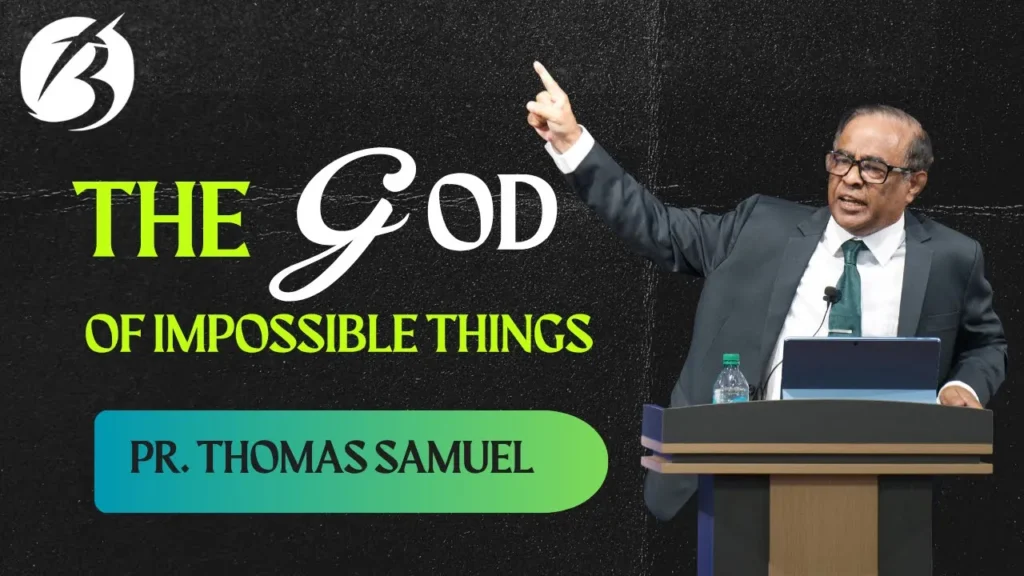
The Unchanging Promise Of God
The Unchanging Promise Of God
Scripture: Jeremiah 32:17
Can God still fulfill His promises when circumstances seem impossible?
In this powerful message, The Promise of God, we explore how God fulfilled His prophetic word – The Unchanging Promise Of God
When we read the Scriptures, we can primarily see miracles on three different levels. “In the beginning God created the heavens and the earth.” Out of nothing,
He brought everything into existence by His powerful word. These are miracles of the highest order—wonders beyond our ability to fully explain.
They are miracles that only the Most High God, who is omnipresent, omniscient, and omnipotent, can perform. The second level of miracles consists of the many miracles God performed through His servants,
which are recorded in Scripture. We can see a man standing before the Red Sea, looking at the roaring waves and wondering how he could ever cross to the other side. As Moses heard the accusations and
complaints of those around him, his heart was broken, and he cried out. At that moment, the Lord said to Moses, “Why are you crying out to Me? Tell the people to move forward.” Then, throughout the entire night,
God caused an east wind to blow, and the sea became dry land. In the book of Joshua, we see another individual. Joshua declared something that no one before him had dared to say. As the battle against the Amorites raged,
Joshua made a declaration of faith: “Sun, stand still over Gibeon, and moon, over the Valley of Aijalon.” As a result, the sun remained shining for nearly an entire day. These two levels of miracles are very familiar to us.
But today, the Holy Spirit is prompting me to share with God’s people about a miracle that belongs to a third level. God performed an unbelievable miracle through a man who had never known Him. In world history,
God illuminated the mind of a man and enabled him to think in a way no one had ever thought before. Behind it all, God had only one purpose. The hopes of sinners had withered away. With weary bodies and broken hearts, t
hey were living under the bondage of a cruel ruler. God took a Gentile man into His hands in order to deliver them. Concerning His people Israel, God revealed through His servant, the prophet Isaiah, the great miracle
He was going to perform. To accomplish a task that the world considered impossible, God enlightened the mind of a Gentile ruler. There was a scientist in the last century who was considered one of the greatest
intellectuals and geniuses of his generation. His name was Albert Einstein. On April 18, 1955, he passed away at Princeton Hospital in New Jersey. Albert Einstein was a physicist known throughout the world.
After his death, something unprecedented happened. If there is any scientist whose brain has been extensively studied by other scientists, it is Albert Einstein. The pathologist who attended him, Dr. Thomas,
removed his brain even without the permission of his family. One remarkable fact about his brain was that it weighed only 1,230 grams, which was lighter than the average human brain. For many years, numerous s
cientists studied his brain. From what I have read about Albert Einstein, I understand that despite being such a brilliant and intelligent man, he used only about two percent of the brain capacity God had given him.
When God illuminated the mind of a Gentile king in order to deliver His people from the bondage of Nebuchadnezzar, an extraordinary event took place in Babylon—something that had never happened before.
How God fulfilled this astonishing prophecy through a Gentile king is a subject deeply intertwined with history and beyond ordinary human understanding.
This is a very broad subject, so I would like to present it briefly in two parts. The subject of today’s message is “The Promise of God.” If God permits and provides another opportunity,
I will share the second part later. God raised up this Gentile king to deliver the people of Israel from captivity. But if people had heard this at that time, they would never have believed it,
because Babylon was a city protected by mighty fortresses and massive walls. No power in the world could break through the city of Babylon and enter it. Let me read the theme verse for today’s message:
“Ah, Lord GOD! Behold, You have made the heavens and the earth by Your great power and outstretched arm. There is nothing too hard for You.” Looking at the Most High God who brought the whole earth into existence out of nothing,
the servant of God declares: “Nothing is impossible for You.” Even in this age, God continues to accomplish great things through human beings whom He created from the dust of the earth. In Matthew 19:26 we read:
“Jesus looked at them and said, ‘With men this is impossible, but with God all things are possible.’” For those listening to this message, let us read Isaiah 44:26–28. Praise God.
This is one of the prophecies in Scripture that has influenced me more than almost any other. In verse 26 we read that Jerusalem will be inhabited.
In verse 28 we read that Jerusalem will be rebuilt and that the foundation of the temple will be laid. From these verses we understand that,
at the time this prophecy would be fulfilled, Jerusalem would become a place without inhabitants. Yet when the prophecy was given, Israel was living in Jerusalem in great numbers.
Therefore, no one who heard this prophecy could believe it. How could Jerusalem, full of people, ever become empty and desolate? What disaster would come upon Israel that would leave God’s city, Jerusalem, deserted?
How would Jerusalem become desolate, and how would Solomon’s temple be destroyed? Isaiah clearly explains that it was because of Israel’s idolatry, disobedience, and rebellion against God
that they were taken into exile in Babylon. As a result, the land became desolate. The temple that Solomon spent seven years building was reduced to ashes in just a few moments.
What destruction came upon the land that left Jerusalem desolate? Let anyone listening read Jeremiah 25:8–11. Praise God. There we see that King Nebuchadnezzar brought great destruction upon Judah.
During the reigns of Jehoiakim and others, many influential Jews and members of the royal family were taken captive to Babylon. Among them were Daniel and his companions Hananiah, Mishael, and Azariah.
Later, when King Zedekiah rebelled, Nebuchadnezzar returned and destroyed the Jerusalem temple that Solomon had labored seven years to build, and he carried most of the remaining Israelites into Babylon.
Thus Jerusalem became desolate, the temple was destroyed, and the divine prophecy was fulfilled at the appointed time, even though many had not believed it.
The Euphrates River flowed through the middle of this city. One of its main gates was an extraordinary architectural structure. It served as the entrance to the city and was decorated with shining blue tiles and various colorful
designs. In that era, such craftsmanship was almost beyond imagination. Another marvel was what became known as one of the Seven Wonders of the World—the Hanging Gardens. According to tradition, there was a queen of Median
descent. She had come from Media, a land filled with lush greenery and beautiful gardens. Babylon was not like that. Therefore, in order to please his queen, the king built a magnificent hanging garden that she could see from
the royal palace. But beyond all these wonders, Nebuchadnezzar built Babylon in such a way that no power in the world could conquer it. Now we can see another picture. This is an artist’s impression of the ancient city of
Babylon. In this picture, Babylon appears divided into two sections, with the Euphrates River rushing through the middle. A massive wall surrounded and protected both sections of the city. When we speak of this wall, we should
not imagine something weak that could be blown away. The wall was about twenty-five feet thick. There was enough space on top of the wall for two chariots to travel side by side. Next to it was a rampart or earthen embankment
built to support the massive wall. Beyond that was a huge moat surrounding the city. The moat was about 260 feet wide. It was partially filled with water, and crocodiles were kept in it. Many ancient kings followed this
practice. They would build large moats around their fortresses and raise crocodiles in them. The belief was that if an enemy somehow managed to enter, the crocodiles would deal with him. Inside this fortification was another
inner wall. It was twenty-one feet wide. Inside that was yet another wall, about twelve feet wide. In this picture, we can see how one side of Babylon was covered and protected by enormous walls. There were gates placed at
intervals. The people depended on the river for their livelihood. If an army laid siege to the city, they would have no problem surviving. They had farmland and abundant fish in the river. There was also a guard force watching
the city twenty-four hours a day. Furthermore, the gates were closed every evening. Even if someone attempted to swim through the river and enter the city, there were barriers placed along the river that could not be broken
through. However, let me remind you of something. I am speaking very briefly because of the limited time available. There came a time when Babylon became proud. But I am not surprised by that. Babylon stood as a wonder of the
world in its day, and that is why pride entered in. In Daniel chapter 4, verses 29–31, we read that the king was walking on the roof of the royal palace in Babylon and said, “Is not this great Babylon, which I have built by my
mighty power and for the glory of my majesty?” While those words were still in the king’s mouth, a voice came from heaven declaring that the kingdom had departed from him. One day, a Gentile king appointed by God arrived with
his great army before the mighty fortifications of Babylon—a city no one thought could ever be conquered. Why did he come? God raised up this Gentile king in order to fulfill the promise He had given through His servant
Isaiah—that after seventy years of captivity in Babylon, He would bring His people back to their own land. When we give our word, we often change it. Sometimes we forget it knowingly or unknowingly. But we can look toward heaven
and declare: “Without remembering my unfaithfulness, my shortcomings, or my failures, my God cares for me. I have a God who fulfills every promise He has spoken.” Let us read Isaiah 44. When Jerusalem lay in ruins and the temple
was reduced to heaps of rubble, God’s prophecy declared that Jerusalem would once again be inhabited. God speaks life into emptiness. He commands that the ruined city be rebuilt and its broken places restored. There is something
even more remarkable in this prophecy. God says, “He is My shepherd, and he shall perform all My pleasure; saying to Jerusalem, ‘You shall be built,’ and to the temple, ‘Your foundation shall be laid.’” God did not wait until
this man was born, grew up, and proved himself to be capable before deciding to use him. One hundred and fifty years before his birth, God revealed through His servant Isaiah the name of the one who would deliver His people:
“Cyrus is My shepherd.” If there is any sacred book that declared a person’s name one hundred and fifty years before he was born, it is the eternal and unchanging Word of God. To accomplish this mission, God did not look for a
great prophet like Isaiah or Jeremiah. Neither did He choose a mighty warrior like Samson. To fulfill His plan and purpose, God anointed and chose a Gentile king named Cyrus. Many times God entrusts responsibilities to us. Yet
we ignore some things and forget others. Perhaps God chose this king to teach us something. Cyrus, who laid the foundation of the Persian Empire, had many other important matters in his life. He had opportunities to gain fame,
build a reputation, and conquer kingdoms. Yet at a time when he did not even know it, the voice of God, the Creator, called him by name and said, “I have chosen you.” This was the man God chose to deliver His people from the
stronghold of Nebuchadnezzar. If a man who ruled only a small region in what is now Iran became the founder of the Persian Empire, it was because of the Almighty God. The Creator knew that the king of such a small territory
could not, by himself, deliver the people of Israel. Therefore, God strengthened him and empowered him to establish an empire so that he could deliver Israel. My dear brother, if God has entrusted you with a task, if God has
given you a ministry, then He will be with you as the God who strengthens you in your weakness. Let me conclude by reading our theme verse once again, Jeremiah 32:17: “Ah, Lord GOD! You have made the heavens and the earth by
Your great power and outstretched arm. Nothing is too difficult for You.” If anyone here is thinking that a situation in your life is impossible, that you will never be able to overcome it, let me remind you today: Take a step
of faith and make this declaration: “Nothing is impossible for You.” Hallelujah! May the Lord God bless us through these words.
More from Series
-

August 2, 2026
Series: Cyrus the Great